By Ha-nui Kim, Engineering Journal
As climate anomalies intensify and the global energy transition accelerates, the need for winter safety infrastructure and high-efficiency heating technologies is becoming increasingly critical. Black ice accidents on roads and walkways during winter continue to drive up social costs, while demand is rapidly growing across diverse sectors—including building energy efficiency, thermal management for electric and commercial vehicle batteries, temperature control in smart farms, and insulation for semiconductor and bio-processing facilities—for new, advanced heating solutions.
In particular, stricter carbon-neutrality regulations, tighter restrictions on deicing chemicals, and the expansion of DC microgrids and renewable-energy integration are exposing the limitations of conventional cable heaters and calcium-chloride spreading methods. Against this backdrop, Nano Electronics Corp. is drawing strong market attention by developing and mass-producing next-generation planar heating technology based on 3D copper nanofibers.
Energy-Saving Smart Heating as a Core Mission
Nano Electronics Corp. has positioned “energy-saving smart heating” as its core mission, delivering solutions across a wide range of applications including road snow-melting, building heating, industrial and mobility thermal management, smart farms, and insulation for semiconductor equipment.
At the heart of its technology is a heating element formed by growing a 3D nanofiber network directly on a film substrate. This structure features low sheet resistance, high durability, and excellent heat dispersion, enabling faster response times and superior temperature uniformity compared to conventional solutions. Based on this platform, the company’s flagship product lineup can be broadly categorized into three key offerings.
Three Core Product Platforms
The first is the “3D Nano Heater,” which leverages an ultra-low-resistance network to reach target temperatures rapidly with minimal power input. Unlike linear heating elements, its planar heating architecture delivers uniform heat distribution across the entire surface.
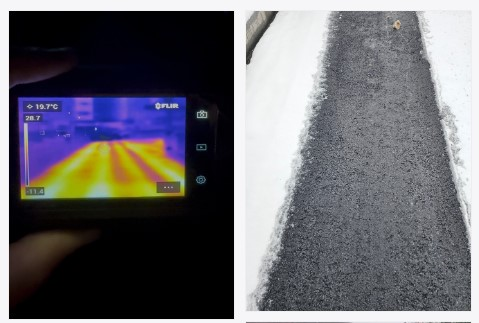
The second is the “EcoWay Road Heating System,” which integrates zone-based power distribution with AI-driven control based on weather and road-surface conditions. This approach minimizes unnecessary operation while completely eliminating the use of deicing chemicals, significantly reducing environmental impact.
The third product, the “Nano Heating Jacket,” features an ultra-thin structure that conforms tightly to curved or complex surfaces, making it well suited for pipe and module insulation. Compared to traditional cable heaters, it offers drastically reduced thickness and weight, hot-spot-free uniform heating, and low-voltage operation, resulting in improved safety.
Clear Advantages over Conventional Deicing Methods
In conventional road deicing, calcium-chloride spreading requires repeated labor- and equipment-intensive operations and accelerates corrosion of vehicles and bridges. Cable heaters, due to their linear heating structure, suffer from heat loss, localized overheating, and inevitably high power consumption.
By contrast, Nano Electronics Corp.’s planar heating system enables section-by-section temperature control and preheating algorithms that significantly reduce power usage, demonstrating energy savings of approximately 30–70% depending on site conditions. At the same time, eliminating deicing chemicals helps mitigate soil and water contamination and reduces premature degradation of road assets.
Manufacturing, Control, and System-Level Innovation
The company’s technological edge is also evident in its manufacturing and control architecture. A roll-to-roll large-area production process ensures cost competitiveness, while laser patterning precisely divides driving zones to enable optimized power distribution.
Its smart controller incorporates temperature and current feedback control, supporting remote monitoring, partial operation, and data-driven maintenance. In addition, waterproof and chemical-resistant coatings ensure stable operation even in extreme cold and saline environments. This end-to-end innovation—from materials and systems to operation—is widely regarded as a key competitive strength of Nano Electronics Corp.
Strong Energy and ESG Impact
The company’s solutions also deliver clear benefits in terms of energy efficiency and environmental performance. Ultra-low-resistance nanofiber networks maximize Joule heating efficiency, while optimized insulation and heat-dissipation design minimize downward heat loss. Compatibility with renewable energy sources such as solar power and ESS further reduces peak loads and supports stable heating infrastructure.
From an ESG and RE100 perspective, the technology offers tangible advantages: reduced environmental burden through zero deicing-chemical usage, enhanced social value via safer infrastructure, and improved transparency through data-driven operation.
Demonstrated Commercial Viability and Ongoing R&D
Nano Electronics Corp. has already completed pilot deployments on roads, ramps, walkways, industrial-park entrances, and logistics-center traffic routes, demonstrating strong commercialization potential. These achievements are widely seen as the result of sustained R&D efforts.
The company is currently collaborating with national research institutes to advance process optimization and reliability evaluation. Extensive testing is underway covering sheet resistance, temperature uniformity, cycle durability, and reliability under salt-spray and damp-heat conditions, with expansion from sample-level development to pilot-scale production. In parallel, Nano Electronics Corp. is participating in national and local government projects to validate performance on real roads and industrial sites, while pursuing joint development and modularization with industrial partners.

Vision for Global Infrastructure Standards
Kim Young-tae, CEO of Nano Electronics Corp., stated, “The value of our technology goes beyond improving heating efficiency—it lies in presenting a new infrastructure model integrated with renewable energy. We will continue to expand scalability so that our solutions can become a core technology for ESG and RE100 implementation.”
Looking ahead, the company plans to introduce site-specific packages for walkways, slopes, and ramps, and to launch Smart Controller 2.0, enhancing AI-based predictive control and remote monitoring. Over the mid- to long term, Nano Electronics Corp. aims to expand mass-production partnerships, quantify carbon-reduction effects, and accelerate entry into the ESG-driven public procurement market. Ultimately, through research into autonomous control and self-healing nanomaterials, the company plans to extend its technology to extreme environments such as space, polar regions, and advanced industrial facilities.
Kim added, “By building the world’s most efficient planar heating platform, we aim to establish a global standard for safe winter infrastructure and energy-saving heating—and to grow into a company that contributes to solving the energy and safety challenges facing industries, cities, and humanity as a whole.”
Source: Engineering Journal (www.engjournal.co.kr)


By Ha-nui Kim, Engineering Journal
As climate anomalies intensify and the global energy transition accelerates, the need for winter safety infrastructure and high-efficiency heating technologies is becoming increasingly critical. Black ice accidents on roads and walkways during winter continue to drive up social costs, while demand is rapidly growing across diverse sectors—including building energy efficiency, thermal management for electric and commercial vehicle batteries, temperature control in smart farms, and insulation for semiconductor and bio-processing facilities—for new, advanced heating solutions.
In particular, stricter carbon-neutrality regulations, tighter restrictions on deicing chemicals, and the expansion of DC microgrids and renewable-energy integration are exposing the limitations of conventional cable heaters and calcium-chloride spreading methods. Against this backdrop, Nano Electronics Corp. is drawing strong market attention by developing and mass-producing next-generation planar heating technology based on 3D copper nanofibers.
Energy-Saving Smart Heating as a Core Mission
Nano Electronics Corp. has positioned “energy-saving smart heating” as its core mission, delivering solutions across a wide range of applications including road snow-melting, building heating, industrial and mobility thermal management, smart farms, and insulation for semiconductor equipment.
At the heart of its technology is a heating element formed by growing a 3D nanofiber network directly on a film substrate. This structure features low sheet resistance, high durability, and excellent heat dispersion, enabling faster response times and superior temperature uniformity compared to conventional solutions. Based on this platform, the company’s flagship product lineup can be broadly categorized into three key offerings.
Three Core Product Platforms
The first is the “3D Nano Heater,” which leverages an ultra-low-resistance network to reach target temperatures rapidly with minimal power input. Unlike linear heating elements, its planar heating architecture delivers uniform heat distribution across the entire surface.
The second is the “EcoWay Road Heating System,” which integrates zone-based power distribution with AI-driven control based on weather and road-surface conditions. This approach minimizes unnecessary operation while completely eliminating the use of deicing chemicals, significantly reducing environmental impact.
The third product, the “Nano Heating Jacket,” features an ultra-thin structure that conforms tightly to curved or complex surfaces, making it well suited for pipe and module insulation. Compared to traditional cable heaters, it offers drastically reduced thickness and weight, hot-spot-free uniform heating, and low-voltage operation, resulting in improved safety.
Clear Advantages over Conventional Deicing Methods
In conventional road deicing, calcium-chloride spreading requires repeated labor- and equipment-intensive operations and accelerates corrosion of vehicles and bridges. Cable heaters, due to their linear heating structure, suffer from heat loss, localized overheating, and inevitably high power consumption.
By contrast, Nano Electronics Corp.’s planar heating system enables section-by-section temperature control and preheating algorithms that significantly reduce power usage, demonstrating energy savings of approximately 30–70% depending on site conditions. At the same time, eliminating deicing chemicals helps mitigate soil and water contamination and reduces premature degradation of road assets.
Manufacturing, Control, and System-Level Innovation
The company’s technological edge is also evident in its manufacturing and control architecture. A roll-to-roll large-area production process ensures cost competitiveness, while laser patterning precisely divides driving zones to enable optimized power distribution.
Its smart controller incorporates temperature and current feedback control, supporting remote monitoring, partial operation, and data-driven maintenance. In addition, waterproof and chemical-resistant coatings ensure stable operation even in extreme cold and saline environments. This end-to-end innovation—from materials and systems to operation—is widely regarded as a key competitive strength of Nano Electronics Corp.
Strong Energy and ESG Impact
The company’s solutions also deliver clear benefits in terms of energy efficiency and environmental performance. Ultra-low-resistance nanofiber networks maximize Joule heating efficiency, while optimized insulation and heat-dissipation design minimize downward heat loss. Compatibility with renewable energy sources such as solar power and ESS further reduces peak loads and supports stable heating infrastructure.
From an ESG and RE100 perspective, the technology offers tangible advantages: reduced environmental burden through zero deicing-chemical usage, enhanced social value via safer infrastructure, and improved transparency through data-driven operation.
Demonstrated Commercial Viability and Ongoing R&D
Nano Electronics Corp. has already completed pilot deployments on roads, ramps, walkways, industrial-park entrances, and logistics-center traffic routes, demonstrating strong commercialization potential. These achievements are widely seen as the result of sustained R&D efforts.
The company is currently collaborating with national research institutes to advance process optimization and reliability evaluation. Extensive testing is underway covering sheet resistance, temperature uniformity, cycle durability, and reliability under salt-spray and damp-heat conditions, with expansion from sample-level development to pilot-scale production. In parallel, Nano Electronics Corp. is participating in national and local government projects to validate performance on real roads and industrial sites, while pursuing joint development and modularization with industrial partners.
Vision for Global Infrastructure Standards
Kim Young-tae, CEO of Nano Electronics Corp., stated, “The value of our technology goes beyond improving heating efficiency—it lies in presenting a new infrastructure model integrated with renewable energy. We will continue to expand scalability so that our solutions can become a core technology for ESG and RE100 implementation.”
Looking ahead, the company plans to introduce site-specific packages for walkways, slopes, and ramps, and to launch Smart Controller 2.0, enhancing AI-based predictive control and remote monitoring. Over the mid- to long term, Nano Electronics Corp. aims to expand mass-production partnerships, quantify carbon-reduction effects, and accelerate entry into the ESG-driven public procurement market. Ultimately, through research into autonomous control and self-healing nanomaterials, the company plans to extend its technology to extreme environments such as space, polar regions, and advanced industrial facilities.
Kim added, “By building the world’s most efficient planar heating platform, we aim to establish a global standard for safe winter infrastructure and energy-saving heating—and to grow into a company that contributes to solving the energy and safety challenges facing industries, cities, and humanity as a whole.”
Source: Engineering Journal (www.engjournal.co.kr)